- OptimistiCallie
- Posts
- ⛈️ Leveraged chaos
⛈️ Leveraged chaos
Record trading in leveraged funds & good trades vs. good theories

Callie Cox
April 06, 2026
Hey hey, happy Monday!
Today, I’m talking to all my traders. Those with short-term objectives who crave chaos and opportunity. You know who you are.
The Compound Insights just released a hot & fresh study with Direxion and Vanda on the soaring popularity of leveraged funds – those ETFs and ETNs that give you ways to double/triple down or short popular stocks and strategies.
We examined how active retail traders use these funds (especially during painful selloffs), where the opportunity lies in trading, and what the future holds for leveraged ETFs and ETNs.
Who knew that just a handful of weeks after our research came out, we’d see record trading activity in leveraged products on the heels of the Iran conflict (and a historic surge in oil prices).
If you’re curious about what The Compound Insights is all about, check out my post on our new research venture. Reach out to Graham Thomas if you want to work with us.
BTW, I’m still on maternity leave, so OptimistiCallie is on hiatus from its regular weekly schedule. Be back soon.
Smash the button below to share OptimistiCallie with a friend 😊
These days, market storms seem to spin up quicker and more dramatically than ever before.
Like this ridiculous swing in oil prices, the largest in at least two and a half decades (probably longer, but that’s as far back as my data goes).
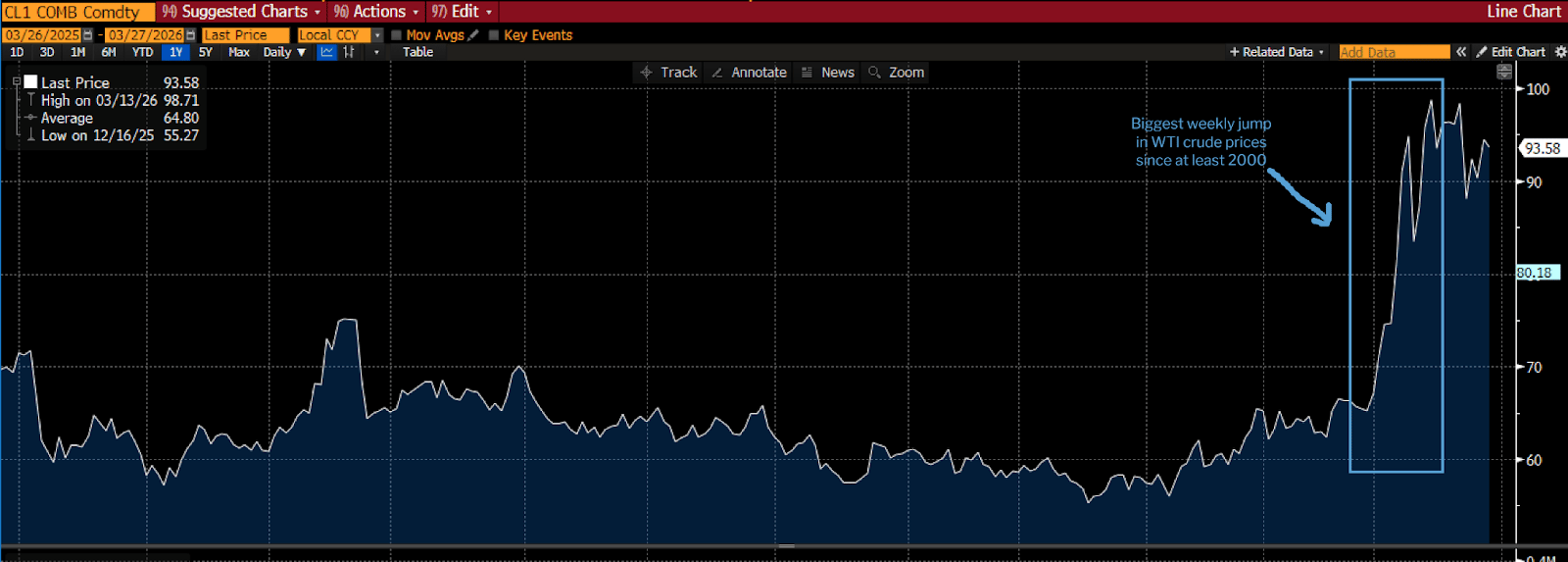
Straight from the Bloomberg terminal so you know we’re not playing around
If you’re like many investors just trying to build a sweet nest egg retirement, you’d just like a little peace and quiet (please and thank you!).
I get it. Big market gyrations are ultimately distractions if you’re investing for decades down the road, and your best approach is often to clench your teeth and do nothing.
But you know what? Some of us just thrive in chaos.
We want a market storm, because storms wash out the dead leaves and stir up new opportunities.
And boy, y’all are absolutely feasting in this particular moment.
You can see this through activity in exchange-traded leveraged products – funds and notes that give traders access to nuanced strategies like doubling down or shorting through. The products achieve these strategies through holding complex instruments like futures and swaps, but they can be easily bought and sold without fancy licenses or lengthy margin agreements.
Leveraged fund turnover – a measure of trading activity (share volume times share price) – reached a record $45.9 billion in March, powered by huge swings in stocks and oil from the Iran conflict.
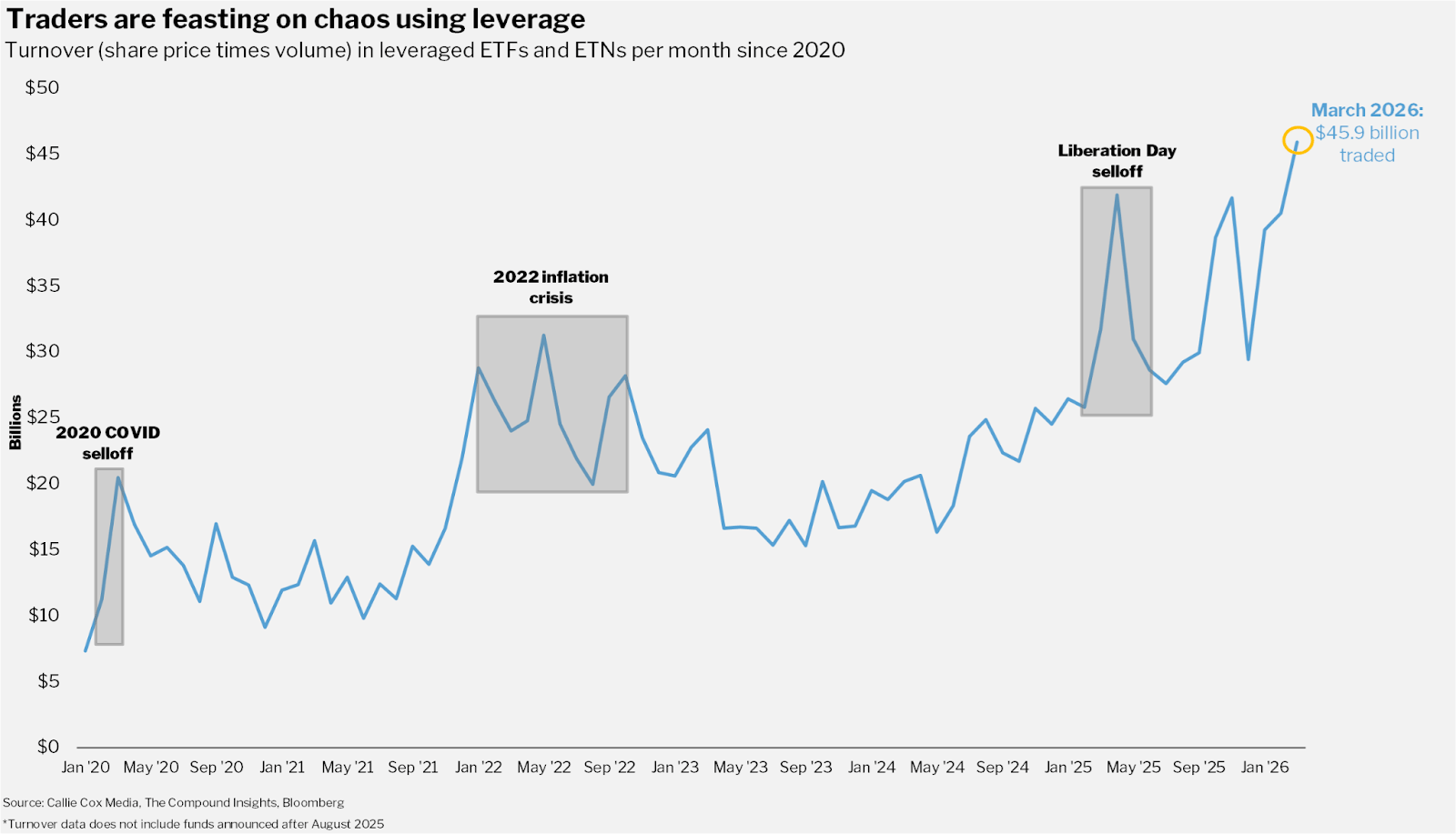
In fact, leveraged ETF and ETNs have caught fire over the last six years, with volumes growing 29% a year since the beginning of 2020. That’s almost triple the pace of stock volume growth.
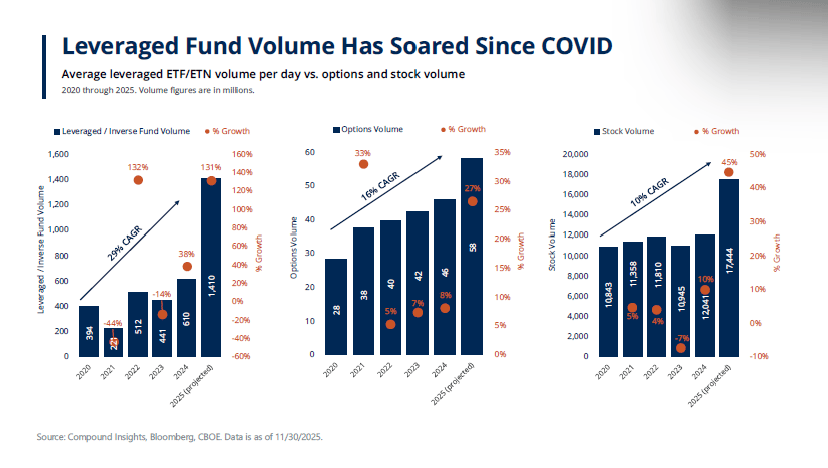
We just can’t get enough. Over history, gut-wrenching swings have chased traders out of markets. Today, these same traders get whipped around, yet they keep coming back – hands outstretched for more.
Direxion (an issuer of leveraged funds), Vanda and I wanted to understand why. We conducted a deep analysis of how traders are using leveraged products, specifically in times of market stress. We wrote a guide to leveraged ETFs and ETNs if you want heady data on the growth of these products and tips on opportunities for traders in these wild days.
The trends are fascinating. Obviously, normal Americans are more sophisticated and empowered in financial markets than ever before. The online community around investing has exploded, and most trades take just a few swipes on your phone.
The moat between Wall and Main Street has dried up, too. For most of Wall Street’s history, it was nearly impossible to trade futures and swaps without deep pockets and the right connections. Yet in the mid-2000s, the first wave of leverage funds proved that even complicated instruments could be made accessible with enough creativity.
Look, I am all for financial access, and trading is one way to learn firsthand how markets work.
But as the world gorges on chaos and speculation, I need you to understand something important:
A good theory isn’t necessarily a good trade.
I remind people of this all the time when they tell me they’re about to YOLO in a stock.
The stories we tell ourselves can be intoxicatingly simple. Sure, you may think oil prices are destined to go down because of TACO or technicals. This market bounced off of this line and Nvidia earnings are always stellar so there’s no way you could lose, right?
Directionally, you may be right for one day. Maybe two. But to absolutely nail a short-term trade – to buy and sell efficiently and at the right times while staying financially afloat – is much harder than it looks.
Plus, you may think you can predict markets, but no one can. Not even Warren Buffett, who regularly admitted that even he – the greatest investor of all time – doesn’t have that elusive crystal ball. Stellar earnings don’t always lead to a rally in the stock price. An exciting stimulus package doesn’t either. Why? Because markets move on expectations, reality and a dash of unquantifiable vibes. Don’t even get me started on trading costs and execution.
Futures and swaps up the ante. People see these 2x leveraged insert stock here funds and pile in because they love the CEO and are convinced the stock price is going to shoot higher. Why not double down if you’re feeling especially confident that Jensen Huang absolutely owns the AI trade?
It’s not that simple. Yes, these products are structured to deliver a degree of levered returns on the underlying strategy…but only for the day.
Then, things get a little more complicated. Each fund re-adjusts its positions daily to achieve its stated objective. When the dust settles, the share price may look different. Over time, these daily rebalances add up, and suddenly, your leveraged fund is (understandably) unmoored from the stock or strategy you thought it would track.
To be clear, leverage can work in your favor. Ultimately, a leveraged fund responds to gains by becoming more aggressive and responds to losses by becoming more defensive. In markets with clear trends, this can be an advantage. But in volatile markets lacking direction, this can be a dagger to your brokerage account.
The Iran conflict has stirred up another storm, and people have strong opinions. It’s never been easier to put money where your mouth is.
But before you risk it all in a tantalizing leveraged instrument, think about what you’re trading and why. Leveraged funds are best used by people with short-term views who have the time, expertise and sanity to move ultra fast and with conviction.
If that’s you, you’ll totally nerd out over the latest research from The Compound Insights, Direxion and Vanda. Download it here.
Thanks for reading!
Callie
Like what you just read? Share it with a friend, pretty please 😊